Freeze Dryer vs. Dehydrator: What’s the Difference and Which One Do You Need?
They both remove water — but the mechanism, the quality of the result, and the economics are worlds apart. A side-by-side comparison of freeze drying and dehydration, for anyone deciding which process fits their product.
In This Article
The Short Answer
A dehydrator removes water with heat — warm air (typically 50–70°C) evaporates moisture over several hours. A freeze dryer removes water with sublimation — the product is frozen solid, then a deep vacuum turns the ice directly into vapour without ever melting it.
That single difference cascades into everything that matters: a freeze dried product keeps up to 97% of its nutrients, its original shape, colour and flavour, and lasts 25+ years. A dehydrated product retains 60–75% of nutrients, shrinks and darkens, and lasts 1–5 years. In return, dehydration is cheaper to buy and faster per batch. Neither is universally “better” — it depends on what you are making and why.
Rule of thumb: If you are preserving delicate, high-value products where appearance, nutrition and rehydration matter — fruit, complete meals, pharmaceuticals, coffee, pet food — freeze drying wins decisively. If you want chewy jerky or banana chips at the lowest equipment cost, a dehydrator is the right tool.
How the Two Processes Actually Differ
Both methods share one goal — drop the moisture content low enough that microorganisms can no longer grow — but they get there through completely different physics.
Dehydration: evaporation with heat
A dehydrator circulates warm air across the product. Heat raises the water to its evaporation point and carries the vapour away. Because the product is warm and passes through a liquid phase, its cell walls collapse, it shrinks, heat-sensitive vitamins degrade, and oxidation darkens the colour. Final moisture content typically settles at 10–20%.
Freeze drying: sublimation under vacuum
A freeze dryer first freezes the product to roughly -30°C to -50°C, then reduces chamber pressure to around 0.05–0.5 mbar. Under that vacuum, ice sublimates — it converts straight from solid to vapour, skipping the liquid stage. Gentle shelf heat drives the process while the product itself stays cold. Because there is no liquid phase and no real heat load, the structure is preserved intact. Final moisture reaches 1–3%.
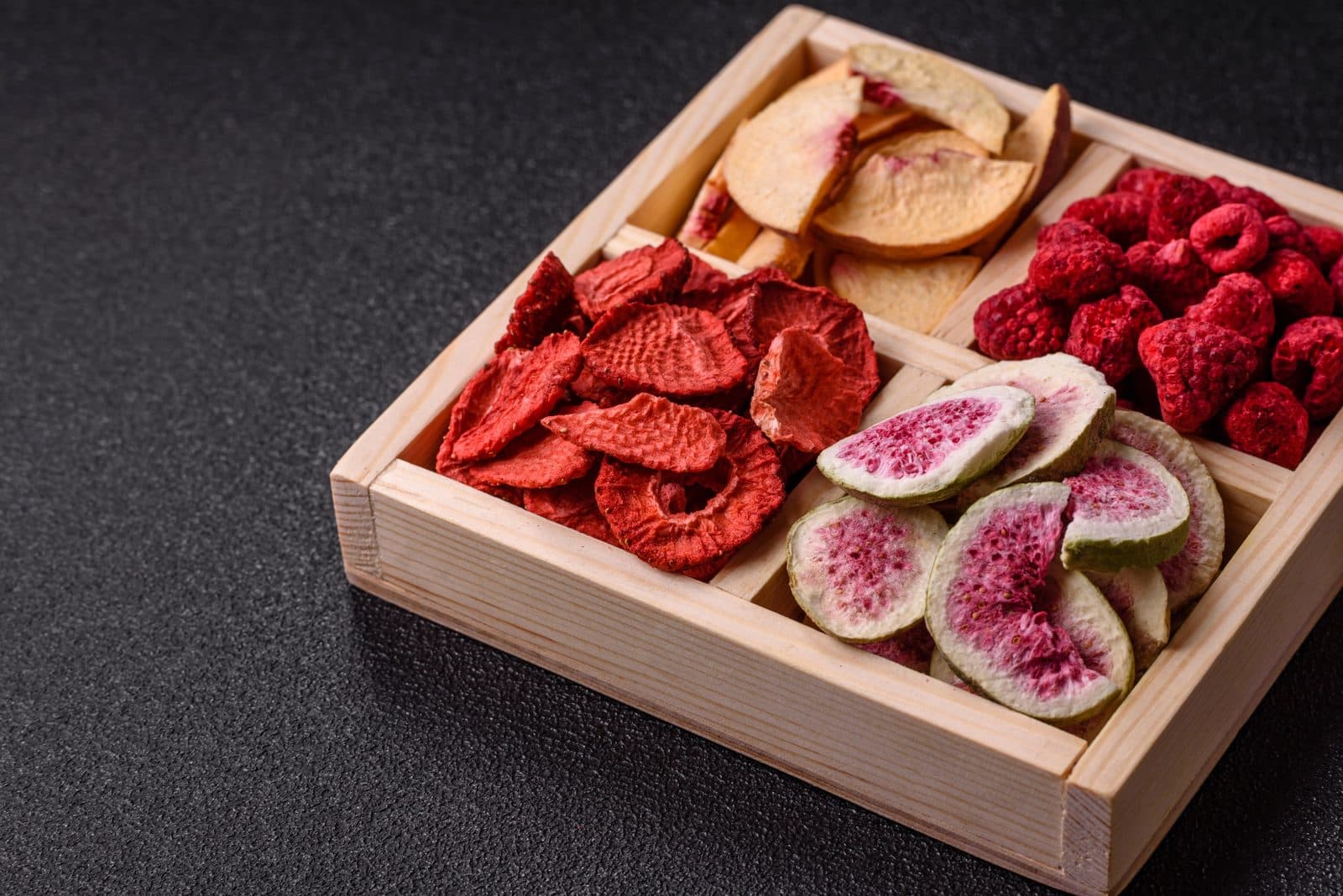
The consequence: a dehydrated strawberry comes out dark, flat and chewy; a freeze dried strawberry comes out bright red, full-shaped, and crisp — and rehydrates in minutes to something close to fresh.
Side-by-Side Comparison
The clearest way to see the trade-off is head to head.
Freeze Dryer
97% nutrition retained
Process: Sublimation under vacuum, low temperature
Final moisture: 1–3%
Texture: Light, crispy, porous — rehydrates fully
Colour: Original colour preserved
Shape: Original shape maintained
Shelf life: 25+ years (properly sealed)
Cycle time: 12–36 hours
Equipment cost: Higher upfront
Best for: Fruit, meals, pharma, coffee, pet food
Dehydrator
60–75% nutrition retained
Process: Hot-air evaporation at 50–70°C
Final moisture: 10–20%
Texture: Tough, chewy, shrunken
Colour: Darkened, oxidised
Shape: Shrunken and wrinkled
Shelf life: 1–5 years
Cycle time: 6–14 hours
Equipment cost: Lower upfront
Best for: Jerky, banana chips, herbs, fruit leather
Quality: Nutrition, Texture, Colour
This is where the gap is widest. Vitamins C and A, many B vitamins, and most enzymes are heat-sensitive — the sustained warmth of dehydration degrades a meaningful share of them. Freeze drying, working cold, leaves the nutritional profile almost intact. Independent studies consistently place freeze dried retention in the mid-90s percent range against 60–75% for hot-air drying.
Texture follows the same logic. Because freeze drying never collapses the cell structure, the product stays porous — which is exactly why it rehydrates so quickly and so completely. Dehydrated food, having shrunk and hardened, rehydrates slowly and rarely returns to its original mouthfeel.
Dehydration isn’t a lesser process — it’s a different one. Some products are defined by the chewy, concentrated character that heat drying creates: beef jerky, banana chips, fruit leather, sun-dried-style tomatoes. For those, freeze drying would actually remove the quality people are paying for.
Shelf Life & Food Safety
Both processes preserve food by removing the water that bacteria, yeast and mould need to grow. But they do not sterilise it. Neither freeze drying nor dehydration reliably kills bacteria — instead they make the environment inhospitable by driving water activity below the threshold microbes require. Any pathogens present before drying can survive in a dormant state and revive on rehydration, which is why safe raw-material handling still matters in both cases.
Where they diverge is how low they push moisture. Freeze drying reaches 1–3% moisture, low enough — when packaged with a moisture barrier and oxygen absorber — for 25-year-plus shelf stability. Dehydration stops at 10–20%, which is dry enough to slow spoilage but still leaves the product vulnerable to eventual mould, oxidation and rancidity, capping practical shelf life at a few years.
Cost, Speed and Throughput
The honest advantage of dehydration is economics. A dehydrator is cheaper to buy, cheaper to run, and finishes a batch faster. For a hobbyist or a small operation making jerky, that can be the whole decision.
Freeze drying carries a higher capital cost and a longer cycle (12–36 hours), because sublimation is inherently slower than evaporation and a vacuum system plus condenser is more complex hardware. But at commercial scale the equation shifts: the finished product commands a far higher price, the 25-year shelf life removes waste and enables global shipping, and the light weight cuts logistics cost. For high-value products, the per-kilo margin on freeze dried output usually more than absorbs the higher processing cost.
Scale matters: Countertop appliances exist for both processes, but industrial freeze drying is a different category — temperature-controlled shelves, deep-vacuum systems and condensers sized for hundreds of kilograms per batch. If you are moving from hobby to production, the machine class, not just the method, is what determines your unit economics.
Which One Should You Choose?
Match the method to the product and the goal:
Choose freeze drying
Fruit, complete meals, coffee, dairy, pharma, raw pet food, anything where colour, nutrition and rehydration matter
Choose dehydration
Jerky, banana chips, fruit leather, herbs — products valued for chewy texture at the lowest equipment cost
Choose industrial freeze drying
Any commercial operation preserving high-value product at scale, where shelf life and per-kilo margin drive the business
If your product is high in value and you are selling on quality, shelf life or export reach, freeze drying is almost always the right long-term investment. If you are making a chewy snack at home or testing a small product line, a dehydrator gets you there faster and cheaper.
Frequently Asked Questions
What’s the difference between a freeze dryer and a dehydrator?
A dehydrator removes water using heat (50–70°C), evaporating moisture over several hours. A freeze dryer freezes the product first, then uses a vacuum to sublimate the ice directly into vapour at low temperature. Freeze drying preserves up to 97% of nutrients, original shape and colour, and reaches 1–3% moisture for 25+ year shelf life; dehydration retains 60–75% of nutrients, shrinks the product, and lasts 1–5 years.
Is a freeze dryer the same as a dehydrator?
No. They share the goal of removing water but use completely different physics. A dehydrator evaporates water with heat; a freeze dryer sublimates ice under vacuum without melting it. The results — nutrition, texture, colour and shelf life — are significantly different.
Does freeze drying kill bacteria?
No. Freeze drying does not sterilise food. It removes the water that bacteria, yeast and mould need to grow, putting any microorganisms into a dormant state — but they can survive and revive when the product is rehydrated. Safe handling of raw materials before drying remains essential. The same is true of dehydration.
How long does freeze drying take compared to dehydrating?
Freeze drying typically takes 12–36 hours per cycle depending on the product, while dehydration usually finishes in 6–14 hours. Freeze drying is slower because sublimation under vacuum is inherently gentler and more gradual than hot-air evaporation — which is exactly what protects the product’s quality.
Is freeze dried food healthier than dehydrated food?
Generally yes, in nutritional terms. Because freeze drying works cold and never collapses the cell structure, it retains far more heat-sensitive vitamins and enzymes — around 97% versus 60–75% for dehydration. Both are healthy, shelf-stable options; freeze drying simply preserves more of the original nutrition.