How to Freeze Dry Without a Freeze Dryer: 4 Methods (and Their Limits)
You can approximate freeze drying at home without a machine — using a freezer, dry ice, or a vacuum chamber. Here’s how each method works, what results to expect, and why none of them match a real freeze dryer.
In This Article
The Short Answer
Yes, you can freeze dry without a dedicated machine — but with important trade-offs. The home methods below rely on the same physics (freezing, then removing water at low temperature), yet none can reproduce the deep vacuum and controlled sublimation of a real freeze dryer. Expect longer times, inconsistent results, higher residual moisture, and shorter shelf life. They’re fine for experiments and small batches; they are not a substitute for commercial production.
Reality check: A true freeze dryer pulls a vacuum to ~0.05–0.5 mbar so ice sublimates directly to vapour. Without that vacuum, water leaves far more slowly and incompletely — which is exactly why home methods take days to weeks and rarely reach the 1–3% moisture needed for 25-year shelf life.
Method 1: The Freezer Method
The simplest approach, requiring nothing but a freezer.
How it works
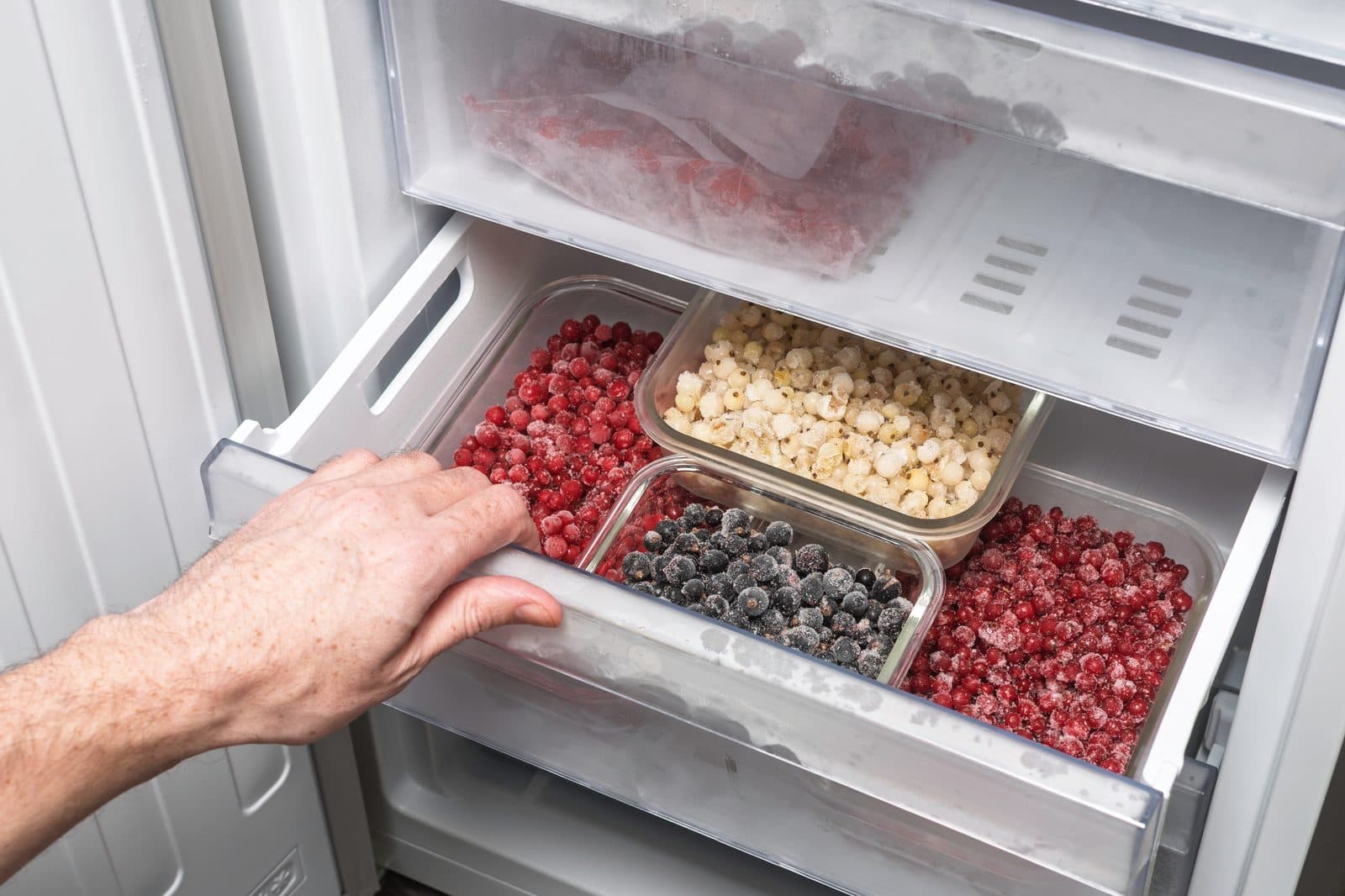
Spread thin pieces of food on a tray, place uncovered in a deep freezer (-18°C or colder), and wait. Over 1–3 weeks, ice slowly sublimates directly into the dry freezer air. When a piece snaps cleanly and shows no cold spot, it’s done.
What to expect
Works best with thin, low-moisture foods (herbs, thin apple slices). Results are inconsistent, moisture removal is incomplete, and shelf life is far shorter than machine freeze drying. Frost-free freezers work better because they actively remove humidity.
Method 2: Dry Ice
Faster than the freezer method, using solid carbon dioxide.
How it works
Place food in a container, surround it with dry ice (roughly equal weight of dry ice to food), and leave the lid loose so gas can escape. The intense cold (-78°C) and the dry CO₂ environment pull moisture out over about 24 hours.
What to expect & safety
Quicker and more effective than the plain freezer, but dry ice requires care: use gloves, never seal the container airtight (pressure build-up), and work in a ventilated space. Results are better but still not as complete or consistent as a machine.
Method 3: Vacuum Chamber + Freezing
The closest DIY approximation to a real freeze dryer.
How it works
Freeze the food solid, then place it in a vacuum chamber connected to a vacuum pump. The low pressure encourages ice to sublimate. This is essentially a manual, uncontrolled version of what a freeze dryer automates.
What to expect
Better moisture removal than the other home methods, but without temperature-controlled shelves and a proper condenser, the process is slow, hard to control, and prone to partial melting. You’re also assembling equipment that, combined, approaches the cost of an entry machine.
Method 4: Freeze-Then-Air-Dry
Not true freeze drying, but a common hybrid.
Freeze the food solid, then move it straight to a dehydrator or cold, dry airflow. Because it starts frozen, some sublimation happens before the food thaws. In practice this is closer to dehydration than freeze drying: you get some of the structure-preserving benefit of starting frozen, but the results have higher moisture, more shrinkage and shorter shelf life than genuine lyophilisation.
Why None Match a Real Freeze Dryer
Every home method runs into the same three walls:
Home methods
Vacuum: none or weak — slow, incomplete sublimation
Moisture: stays high (5–15%+)
Time: 1 day to several weeks
Consistency: unpredictable, batch to batch
Shelf life: weeks to a couple of years
Real freeze dryer
Vacuum: 0.05–0.5 mbar — full sublimation
Moisture: 1–3%
Time: 12–36 hours, controlled
Consistency: repeatable, recipe-driven
Shelf life: up to 25 years
The difference isn’t effort — it’s physics. Only a controlled vacuum plus temperature-controlled shelves and a cold condenser can drive moisture low enough for true shelf stability. For the full mechanism, see how industrial freeze drying works.
When It’s Worth Getting a Machine
Home methods are great for curiosity and the occasional small batch. But if you want reliable results, proper shelf life, or any kind of volume — a product line, a business, repeatable quality — the physics make a real freeze dryer the only practical answer. At that point the question shifts from “how do I avoid a machine” to “which machine fits my output.” For a commercial operation, an industrial freeze dryer turns these unreliable multi-day experiments into predictable, high-volume production.
If you’re moving from hobby batches toward selling a product, the machine class determines your cost per kilogram and your consistency. That’s a different decision than any DIY method can inform.
Frequently Asked Questions
Can you freeze dry without a freeze dryer?
Yes, approximately — using a deep freezer, dry ice, or a vacuum chamber with a frozen product. All rely on sublimating ice at low temperature. However, without a strong controlled vacuum they are slower, less complete and less consistent than a real freeze dryer, and rarely achieve long shelf life.
How long does the freezer method take?
Typically 1 to 3 weeks, depending on the food’s thickness and moisture and how dry your freezer air is. Frost-free freezers work faster because they actively remove humidity. Even then, moisture removal is incomplete compared with a machine.
Is dry ice freeze drying safe?
It can be, with precautions: wear gloves to avoid frostbite, never seal the container airtight (CO₂ gas builds pressure), and work in a ventilated area. It’s faster than the freezer method but still less complete than a real freeze dryer.
Is home freeze drying as good as a machine?
No. Home methods leave more residual moisture (5–15%+ vs 1–3%), give inconsistent results, and produce much shorter shelf life. They’re fine for experiments but not for reliable storage or any commercial use.
What’s the closest DIY method to real freeze drying?
A vacuum chamber with a vacuum pump, using pre-frozen food. It reproduces the freeze-plus-vacuum principle, but lacks the controlled shelf heating and condenser of a real freeze dryer, so it’s slower and harder to control.