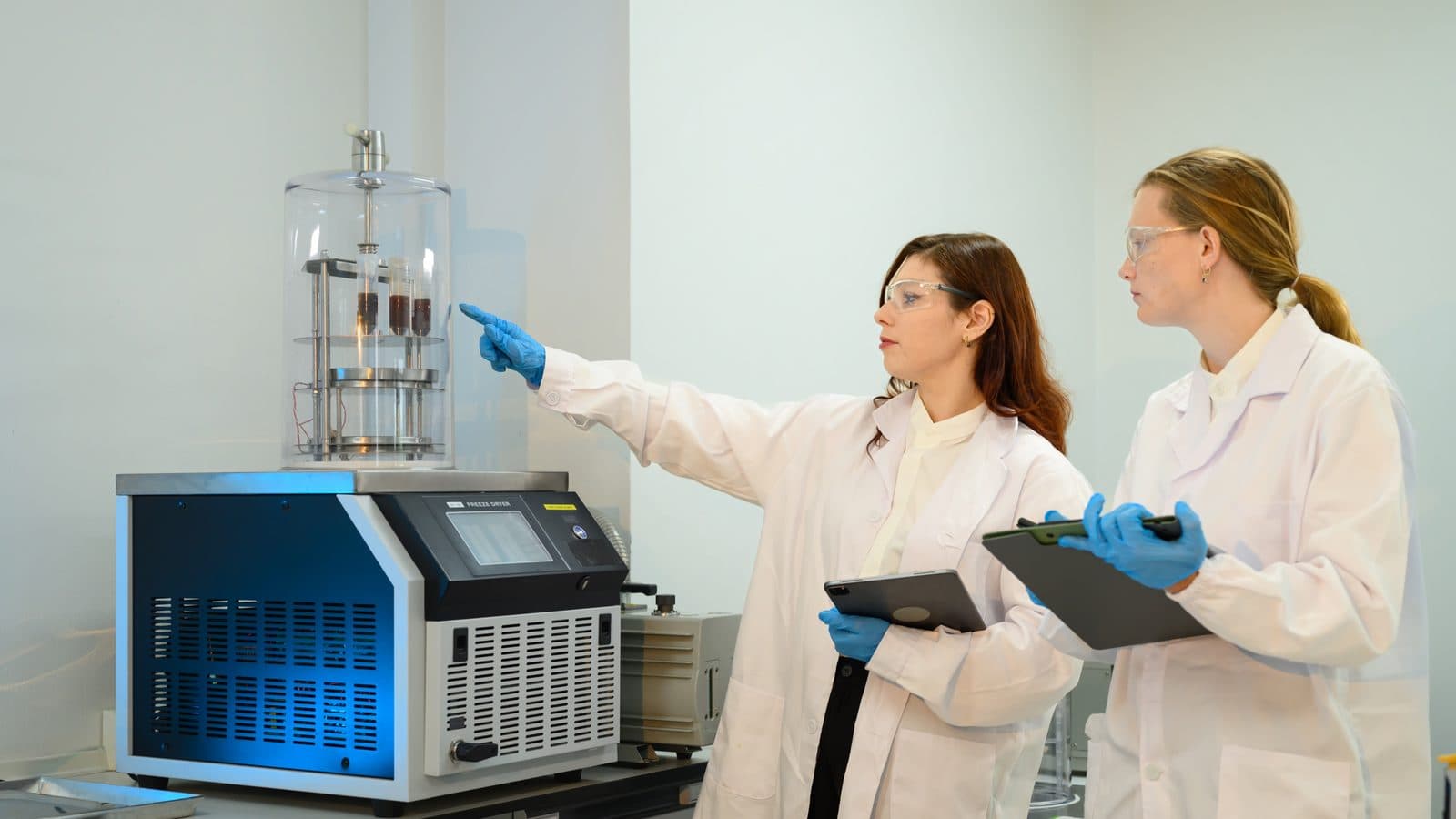
What Is Lyophilization? A Plain-English Guide to Freeze Drying
Lyophilization is the scientific name for freeze drying — the process behind everything from instant coffee to life-saving vaccines. Here’s what the term means, how the process works, and where it’s used.
In This Article
Definition: What Lyophilization Means
Lyophilization is a low-temperature dehydration process that removes water from a frozen product by sublimation — converting ice directly into vapour under vacuum, without it ever passing through the liquid phase. It is exactly the same process most people know as freeze drying; “lyophilization” is simply the term used in science, pharmaceuticals and biotech.
In one sentence: Lyophilization = freeze drying. Freeze it solid, pull a deep vacuum, and let the ice turn straight to vapour — leaving a dry, stable product that keeps its structure, potency and flavour.
Where the Word Comes From
The term comes from the Greek lyo (“to loosen” or “dissolve”) and philos (“loving”). Literally, it describes a material that “loves to dissolve” — a fitting name, because a properly lyophilized product is porous and readily reabsorbs its solvent, rehydrating quickly and completely when water is added back. That is why a freeze dried strawberry snaps back close to fresh, and why a lyophilized drug dissolves cleanly when reconstituted before injection.
How Lyophilization Works
Every lyophilization cycle runs through three stages:
Freezing
The product is frozen solid, typically to -30°C to -50°C — below its eutectic or collapse temperature — so that all the water becomes ice. How it’s frozen affects ice-crystal size, which influences the speed and quality of the rest of the cycle.
Primary drying (sublimation)
The chamber pressure is dropped to roughly 0.05–0.5 mbar and gentle heat is applied through the shelves. Under vacuum, the ice sublimates directly to vapour, which is captured on a cold condenser. This stage removes the bulk of the water — around 90–95% — and takes the most time.
Secondary drying (desorption)
Shelf temperature is raised further (often 20–40°C) to drive off the small amount of water still bound to the product at a molecular level, bringing final moisture down to 1–3% for long-term stability.
For a deeper engineering walkthrough of these stages, see our guide on how industrial freeze drying works.
Why It’s Used Instead of Other Drying
Conventional drying uses heat to evaporate water, which degrades sensitive compounds, collapses structure and alters colour and flavour. Lyophilization works cold and never melts the product, so it preserves what heat would destroy:
Lyophilization
Preserves structure & potency
Temperature: Low — product stays frozen
Water removal: Sublimation under vacuum
Final moisture: 1–3%
Result: Porous, stable, rehydrates fully
Shelf life: Years to decades
Heat drying
Degrades sensitive compounds
Temperature: High — 50–90°C
Water removal: Evaporation
Final moisture: 10–20%
Result: Shrunken, altered, partial rehydration
Shelf life: Months to a few years
Where Lyophilization Is Used
Pharmaceuticals
Vaccines, biologics, antibiotics, injectables that are unstable in liquid form
Biotech & diagnostics
Enzymes, antibodies, reagents, reference cultures
Food & beverage
Instant coffee, fruit, complete meals, flavour powders
Pet food
Raw freeze-dried food and single-ingredient treats
Lyophilization in Pharma & Biotech
In medicine, lyophilization solves a core problem: many drugs — especially biologics and vaccines — degrade quickly in solution. Freeze drying them into a stable “cake” extends shelf life dramatically, allows storage and shipping without a constant cold chain, and lets the product be reconstituted to full potency at the point of use by adding sterile water.
Crucially, lyophilization preserves sterility and potency — it does not create them. The product must be sterile and correctly formulated going in. For the pharmaceutical-specific process, cycle development and cake quality, see our dedicated guide to pharmaceutical freeze drying.
Frequently Asked Questions
What is lyophilization?
Lyophilization is the scientific term for freeze drying: a low-temperature process that removes water from a frozen product by sublimation under vacuum, turning ice directly into vapour. It preserves structure, potency and flavour, and is widely used in pharmaceuticals, biotech and food.
Is lyophilization the same as freeze drying?
Yes. They describe the identical physical process. “Lyophilization” is the standard term in pharmaceutical, biotech and scientific settings, while “freeze drying” is more common in food and consumer contexts.
What does the word lyophilization mean?
It comes from the Greek lyo (dissolve/loosen) and philos (loving), meaning “solvent-loving.” It refers to how a freeze dried product readily reabsorbs water and rehydrates quickly and completely.
Why are drugs lyophilized?
Because many drugs — particularly vaccines and biologics — are unstable in liquid form. Lyophilizing them into a dry, stable cake extends shelf life, eases storage and shipping, and allows reconstitution to full potency at the point of use.
Does lyophilization sterilise the product?
No. Lyophilization preserves whatever microbial state the product was in — it does not kill microorganisms. Sterility in pharmaceutical lyophilization comes from working with sterile material under aseptic conditions, not from the freeze drying itself.