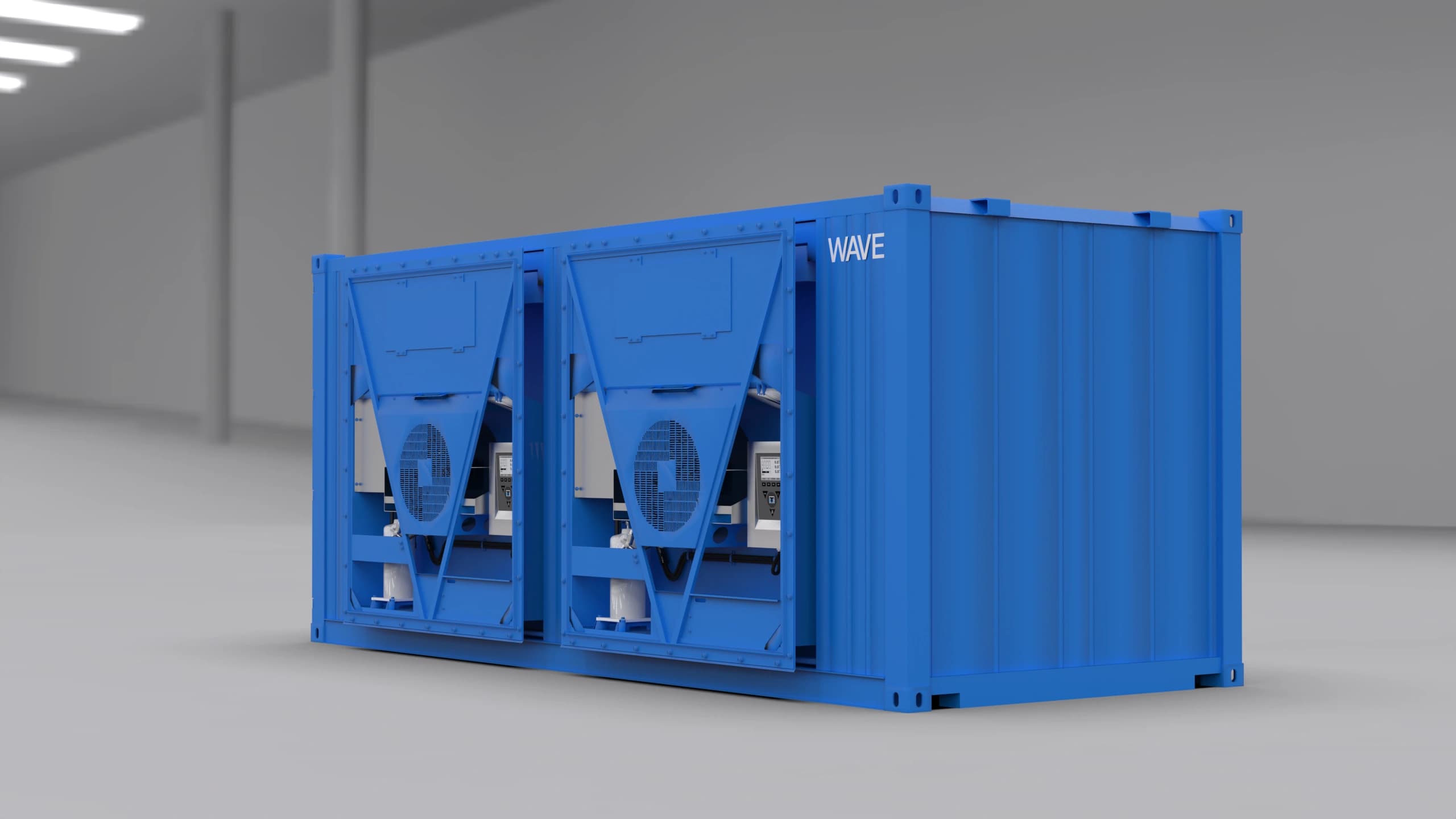
Blast Freezer Container: Planning a Containerised Freezing Room
When a 20 ft or 40 ft blast freezer container makes sense, which data size the refrigeration and what the WAVE BIG WINTER BLAST 20 and 40 cost.
In this article
The short answer
A blast freezer container is an insulated shipping-container body with refrigeration sized to freeze warm or chilled product in batches, not just to hold it frozen. It gives a production or logistics site its own freezing room without building one. WAVE offers the BIG WINTER BLAST 20 and BLAST 40 as configurable designs with provisional guide prices of €35,760 and €69,000 net.
Key point: the refrigeration of a blast freezer is designed around your batch — product, weight, incoming and target core temperature and cycle time. Two containers that look identical from the outside can need very different equipment inside.
Storage container or blast freezer?
A storage freezer container holds product that arrives already frozen. Its refrigeration only has to remove the heat that enters through the walls, the doors and small additions of goods. A blast freezer has a different task: it must extract the heat of a full batch — including the latent heat released when the water in the product turns to ice — within a defined time.
That is why blast freezers need much more refrigeration capacity and strong, directed airflow across the product. Using a storage container to freeze large warm loads leads to long freezing times, slow crystallisation and, in many cases, an overloaded unit.
| Storage container | Blast freezer container | |
|---|---|---|
| Task | Keeps frozen product at temperature | Freezes batches of chilled or warm product |
| Refrigeration sized for | Heat entering the box | Heat removed from the product per cycle |
| Airflow | Even distribution | Directed through the load |
| WAVE models | BIG WINTER 20 / 40 | BIG WINTER BLAST 20 / 40 |
BIG WINTER BLAST 20 and 40
| Specification | BIG WINTER BLAST 20 | BIG WINTER BLAST 40 |
|---|---|---|
| Format | 20 ft | 40 ft High Cube |
| External dimensions (L × W × H) | 6,058 × 2,438 × 2,591 mm | 12,192 × 2,438 × 2,896 mm |
| Refrigeration units in this design | 2, side-mounted | 5, side-mounted |
| Compressor power | 2 × 7.3 kW = 14.6 kW | 5 × 7.3 kW = 36.5 kW |
| Loading | Front container cargo doors | |
| Provisional guide price (net) | €35,760 | €69,000 |
The side-mounted refrigeration units keep the normal cargo doors free for loading. Refrigeration capacity and refrigerant are selected for the operating conditions of each project. The guide prices exclude VAT and transport; the final price follows the technical specification in your quotation.
What determines the design
Data needed to size a blast freezer container
- Product: what is frozen, piece size and water content.
- Weight per batch and the number of batches per day.
- Incoming temperature and the target core temperature.
- Cycle time: how quickly the batch must be frozen.
- Packaging and loading: trays, boxes, pallets or trolleys — they decide how air can flow through the load.
- Location: ambient temperature, sun exposure and available space.
- Electrical supply available on site.
The loading layout is part of the refrigeration design. Tightly stacked cartons freeze slowly in the centre even with high air speed, because the air never reaches the inner layers. Gaps between layers, open trays or trolleys with defined spacing often shorten freezing more than additional compressor power would.
Site, power and loading
WAVE coordinates footprint, service clearances, power supply, condensate drainage and commissioning with each site. Plan a level, load-bearing surface, enough space in front of the doors for pallet trucks or trolleys and access to the refrigeration units on the side. If the container is to be connected to an existing loading dock or building, include this in the first enquiry, because it affects the orientation of the doors and units.
Freezing and storage are separate tasks. Many operations combine a blast freezer for incoming batches with a storage container that holds the frozen stock until it is processed or shipped.
Blast freezing before freeze drying
Freeze-drying producers often buy fruit, vegetables or meat during a short harvest or slaughter window and then process them over weeks. Fast freezing forms smaller ice crystals, which helps texture after drying, and frozen product can go straight into a WAVE freeze dryer without a separate freezing step. For the storage side of that buffer, read our guide to the BIG WINTER 20 and 40 storage containers.
Frequently asked questions
What does a blast freezer container cost?
WAVE quotes provisional guide prices of €35,760 for the BIG WINTER BLAST 20 and €69,000 for the BIG WINTER BLAST 40, net, excluding VAT and transport. The final price depends on the technical design.
How fast does a blast freezer container freeze?
That depends on the product, batch weight, packaging and the target core temperature. WAVE sizes refrigeration capacity and airflow for the cycle time you need instead of quoting a generic figure.
Can a normal reefer container be used as a blast freezer?
A storage container is designed to hold frozen product at temperature. Freezing large warm batches requires much more refrigeration capacity and directed airflow, which is what the BLAST design provides.
How is the container loaded?
Through the normal front cargo doors. The side-mounted refrigeration units keep the door end free for pallets, boxes or trolleys.
Which refrigerant is used?
Refrigeration capacity and refrigerant are selected for the operating conditions of each project and stated in the quotation.
Size your blast freezer container
Tell us your product, batch weight, temperatures, cycle time and site. WAVE specifies refrigeration, airflow and equipment for your process.
View BIG WINTER BLAST