Nitrogen Generator for Food Production: How to Size a PSA System
On-site nitrogen at 99.9 % purity for packaging, inerting and freeze-dryer venting: how PSA works, which output you need and what the WAVE N2 models cost.
In this article
The short answer
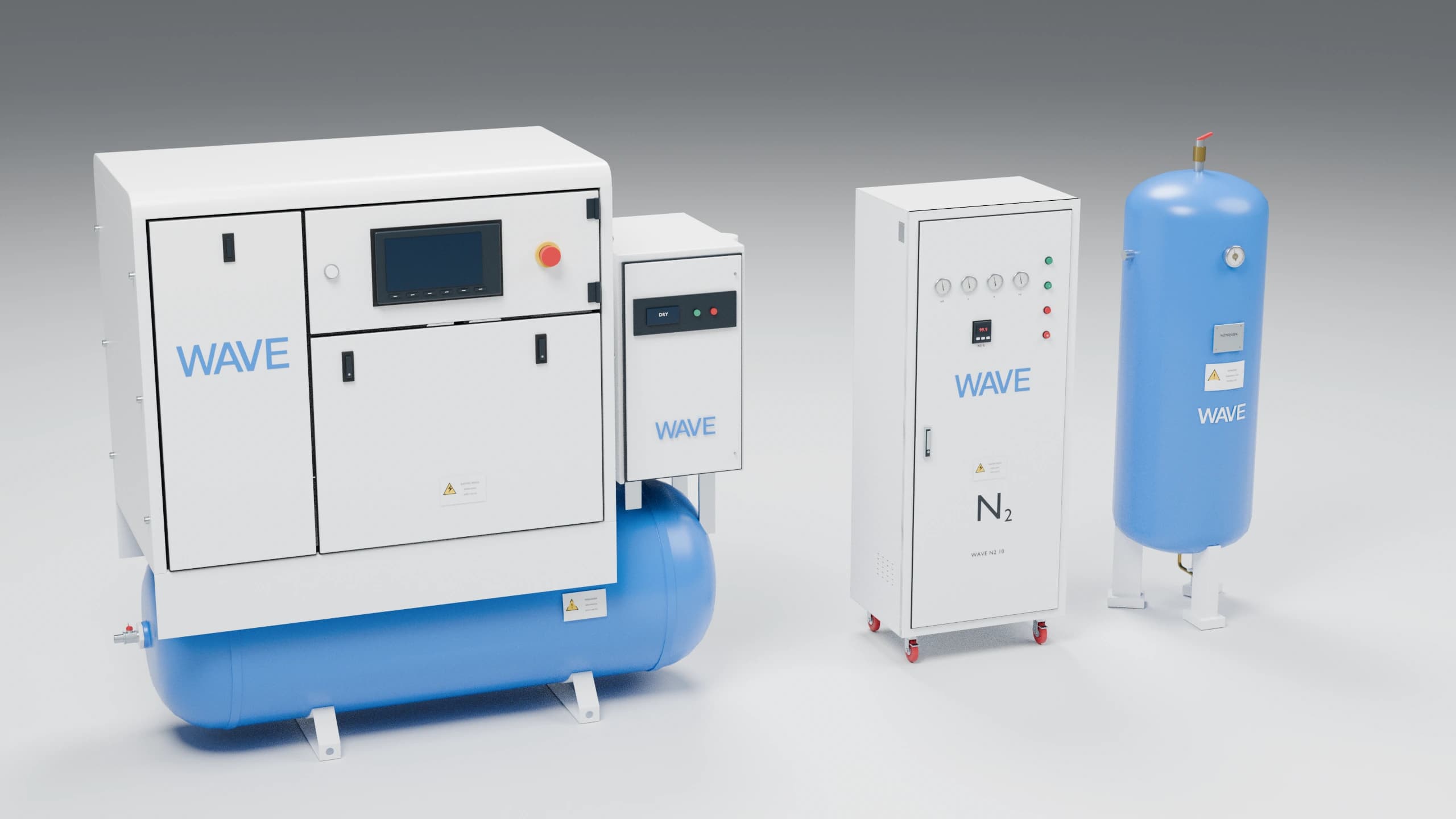
A nitrogen generator separates nitrogen from compressed air on site, so a production line no longer depends on cylinder deliveries. The WAVE N2 range uses pressure swing adsorption (PSA) and delivers 3, 10, 20 or 40 Nm³/h at 99.9 % purity. Each system is supplied complete with screw compressor, air treatment, PSA unit and a 300 L nitrogen storage tank. Net prices start at €11,900 for the N2 3.
Rule of thumb: size the generator on your continuous demand and let the storage tank cover short peaks. Required purity and pressure at the point of use matter as much as the flow rate.
How a PSA nitrogen generator works
Ambient air contains about 78 % nitrogen. A PSA generator pushes clean, dry compressed air through a vessel filled with an adsorbent that holds back oxygen and other components while nitrogen passes through. In a typical PSA design two adsorber beds alternate: one produces nitrogen while the other is depressurised and regenerated. The cycle repeats automatically and the product gas flows into the storage tank.
The quality of the compressed air decides how well the adsorbent performs over the years. That is why every WAVE N2 system includes a refrigerated air dryer and filtration upstream of the PSA unit. On the N2 3, N2 10 and N2 20 these components are combined in a compact four-in-one air station with a 380 L air receiver. The N2 40 uses separate components: a 22 kW screw compressor, a 1,000 L air receiver, a separate refrigerated dryer and four-stage filtration.
Where producers use nitrogen
Nitrogen is inert, dry and odourless, which makes it a practical protective gas wherever oxygen or moisture would damage a product:
- Packaging: flushing pouches, jars and trays with nitrogen (modified-atmosphere packaging) lowers the residual oxygen around the product.
- Dry and freeze-dried products: freeze-dried food is strongly hygroscopic and sensitive to oxidation. Filling under nitrogen helps protect colour, aroma and fats after the drying cycle.
- Venting a freeze dryer: at the end of a cycle the chamber can be brought back to atmospheric pressure with dry inert gas instead of humid room air.
- Laboratories and production: blanketing tanks, purging lines and protecting sensitive materials.
Purity requirements differ by application. 99.9 % is sufficient for many packaging and inerting tasks; if your process or your customer specifies a higher purity or a particular gas specification, state it in your enquiry so that the configuration can be checked against it.
WAVE N2 models and prices
| Model | Nitrogen output | Compressed-air supply | Net price |
|---|---|---|---|
| WAVE N2 3 | 3 Nm³/h at 99.9 % | Four-in-one station, 7.5 kW, 1.1 m³/min | €11,900 |
| WAVE N2 10 | 10 Nm³/h at 99.9 % | Four-in-one station, 7.5 kW, 1.1 m³/min | €14,900 |
| WAVE N2 20 | 20 Nm³/h at 99.9 % | Four-in-one station, 1.5 m³/min | €18,900 |
| WAVE N2 40 | 40 Nm³/h at 99.9 % | Separate air treatment, 22 kW, 3.5 m³/min | €24,900 |
All four systems work with a PSA feed-air pressure of 0.8 MPa and deliver nitrogen at 0.6 MPa. The compressor delivers up to 8 bar and runs on 400 V, 50 Hz, three-phase; the PSA unit itself runs on 220 V, 50 Hz, single-phase. Prices are net, ex WAVE warehouse in Europe; delivery and commissioning are quoted separately.
The figures for the PSA unit (0.1 kW or 0.3 kW) are component ratings and not the energy consumption of the complete system — almost all of the energy goes into producing compressed air. Reference conditions for the nominal flow, connection sizes and installation dimensions are confirmed in the quotation.
How to size the system
Information WAVE needs for a binding configuration
- Application: packaging, inerting, venting or a mix of uses.
- Continuous demand in Nm³/h during a normal shift.
- Peak demand and how long it lasts — for example when a packaging machine starts or a freeze-dryer chamber is vented.
- Purity required at the point of use.
- Pressure required at the consumer.
- Operating hours per day and per week.
- Installation site, available electrical supply and any existing compressed-air system.
Consumption is often underestimated when it is calculated only from the packaging machine's data sheet. Leaks, purge losses and simultaneous users add up. If several machines draw nitrogen at the same time, add their peaks, not their averages, and use the 300 L tank as a buffer rather than as a substitute for generator capacity.
The listed configuration is specified for 400 V / 50 Hz. If your site uses a different network, mention it in your enquiry before choosing a model.
Generator or cylinders?
Cylinders and bundles remain practical for occasional, small consumption. A generator becomes interesting when nitrogen is used every day in a predictable pattern: the gas is produced where it is needed, there are no rental fees or delivery schedules, and the plant is no longer exposed to an empty cylinder halfway through a packaging run. The decision depends on your actual consumption profile, which is why sizing starts with demand data rather than with a model name.
Producers who are setting up freeze-drying lines often plan nitrogen together with the dryer and the packaging step. WAVE builds freeze dryers from the FD260 to the IC570MAX and can include the N2 system in the same project.
Frequently asked questions
What purity does a WAVE nitrogen generator deliver?
All WAVE N2 models deliver their nominal output at 99.9 % nitrogen purity. If your application specifies a different purity, the configuration is checked against it in the quotation.
How much does a nitrogen generator cost?
WAVE N2 systems cost €11,900 (3 Nm³/h), €14,900 (10 Nm³/h), €18,900 (20 Nm³/h) and €24,900 (40 Nm³/h), net, including compressor, air treatment, PSA unit and 300 L storage tank. Delivery and commissioning are quoted separately.
Is a compressor included?
Yes. Every WAVE N2 system includes a screw compressor, air receiver, refrigerated air dryer, filters, the PSA unit and a 300 L nitrogen tank with interconnecting piping.
Which model do I need?
Start from your continuous demand in Nm³/h, add the peaks of all users that run at the same time and check purity and pressure at the point of use. WAVE recommends the model once these figures are known.
Can nitrogen be used to vent a freeze dryer?
Yes, a freeze-dryer chamber can be brought back to atmospheric pressure with dry nitrogen instead of room air. Whether this suits your product and machine is clarified during project planning.
Plan your nitrogen supply
Send us your application, demand in Nm³/h, purity, pressure and operating hours. WAVE will match the N2 system and scope of supply to your process.
View the WAVE N2 range