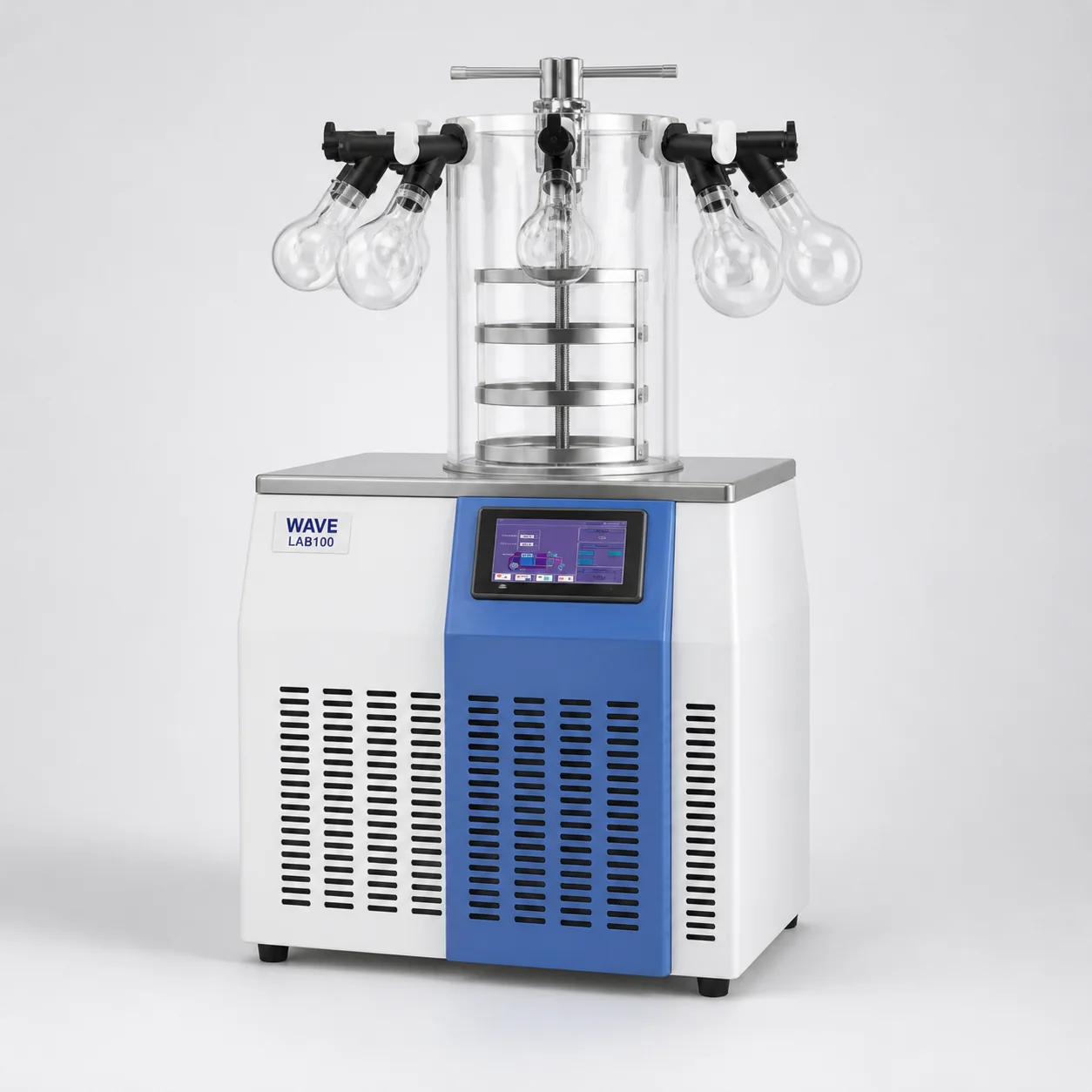
WAVE LAB Series: LAB100, LAB120 and LAB180 Compared
Three compact laboratory freeze dryers from €4,780, with cold traps down to -80 °C, an 8-port manifold and configurations for trays or vial stoppering.
In this article
The short answer
The WAVE LAB Series consists of three compact laboratory freeze dryers. LAB100 and LAB120 are PT models for trays, freeze-drying flasks and stoppering vials under vacuum. LAB180 P is intended for larger tray loads. All three have an 8-port manifold, a colour touchscreen, process curves and USB data export.
Selection rule: choose LAB100 for small routine loads, LAB120 when the same load needs more cold-trap reserve, and LAB180 when tray area and total liquid load are the deciding factors.
LAB100, LAB120 and LAB180 compared
| Specification | LAB100 PT | LAB120 PT | LAB180 P |
|---|---|---|---|
| Indicative base price | €4,780 | €5,900 | €7,450 |
| Water capture | 3-4 L/24 h | 3-4 L/24 h | 6 L/24 h |
| Cold-trap volume | 6 L | 9 L | 28 L |
| Drying area | 0.08 m² | 0.08 m² | 0.27 m² |
| Maximum liquid load | 1.6 L | 1.6 L | 5.4 L |
| Trays | 3 | 3 | 6 |
| Vial stoppering | Yes | Yes | No, standard P chamber |
The cold trap is available down to -80 °C without load and is order-specific. Ultimate vacuum is specified at ≤ 5 Pa. A typical drying cycle takes 24-36 hours, but the actual time depends on formulation, fill depth, freezing method, condenser load and target residual moisture.
Which model fits which workflow?
LAB100: compact entry point
LAB100 suits research, method development and small batches where a 1.6-litre maximum total liquid load is sufficient. Its PT chamber permits vials to be stoppered under vacuum, while the manifold supports up to eight compatible freeze-drying flasks.
LAB120: more condenser reserve
LAB120 retains the same tray area and liquid-load range as LAB100 but increases cold-trap volume from 6 to 9 litres. It is the logical choice when the sample load is similar but more condenser reserve is valuable for the workflow.
LAB180: more tray area and load
LAB180 increases drying area to 0.27 m² across six trays and raises maximum total liquid load to 5.4 litres. It uses a standard P chamber rather than a stoppering chamber and therefore targets larger tray-based laboratory batches.
How to read the specifications
Water capture is not the same as sample capacity. The 3-4 or 6 litres per 24 hours describe how much water the system can condense under stated conditions. The recommended sample load is lower: 0.8 litres for LAB100 and LAB120 and 2.7 litres for LAB180. Product composition and fill depth can reduce or extend both capacity and cycle time.
The touchscreen displays sample temperature, cold-trap temperature and vacuum as live values and curves. USB export provides a process record for development work and internal documentation. These functions support traceability, but they do not by themselves constitute GMP qualification or process validation.
Price and scope of supply
Indicative base prices start at €4,780 for LAB100, €5,900 for LAB120 and €7,450 for LAB180. A vacuum pump is required; the oil-free WAVE WDry10 scroll pump is available as an option. Shipping, voltage configuration, taxes, commissioning requirements and application-specific accessories are confirmed in the formal quotation.
The complete, current configuration and downloadable technical sheet are available on the WAVE LAB Series product page.
Frequently asked questions
What is the difference between LAB100 and LAB120?
Both offer three trays, 0.08 m² drying area, up to 1.6 litres total liquid load and PT stoppering. LAB120 increases cold-trap volume from 6 to 9 litres.
Can the WAVE LAB models stoppered vials under vacuum?
LAB100 and LAB120 use PT stoppering chambers. LAB180 is a P configuration for higher tray capacity and does not include stoppering.
Is the vacuum pump included in the base price?
No. The required vacuum pump is configured separately; an oil-free WAVE WDry10 scroll pump is available as an option.
Are the machines GMP qualified?
The LAB Series provides process monitoring and data export, but GMP qualification and validation depend on the configured system, documentation package, installation and intended regulated process.
Configure the WAVE LAB Series
Compare all three models, select a vacuum pump and request a formal quotation with lead time and shipping.
Compare LAB models